Skip to content
GOOD CHEMISTRY · WE MEAN BOTH KINDS
TELEIOS / POULTRY INTERVENTIONS
▸ POULTRY ANTIMICROBIAL INTERVENTION PROGRAMS

Intervention Programs Built for Real Plant Performance.

Poultry antimicrobial intervention is not just a chemistry decision. It's a food safety decision, a product quality decision, a worker safety decision, a maintenance decision, and a service decision. Teleios builds programs around the outcomes that actually matter on the line.

WHAT IT MEANS IN THE PLANT

What Poultry Antimicrobial Intervention Means in the Plant.

A poultry antimicrobial intervention program is the system of chemistry, equipment, monitoring, and service that helps reduce pathogen risk at key points in the process. The chemistry matters. So does where it is applied, how consistently it is controlled, how the product responds to it, and whether the program can be defended with data when QA, customers, or auditors come asking.

Modern poultry food safety does not rely on a single silver bullet. It relies on a multi-hurdle approach — a series of sequential controls that each contribute to microbial reduction as product moves through the line. No single intervention point carries the whole program. Each one earns its place.

▸ WHERE IT SHOWS UP ON THE LINE
01
Inside-outside bird washer (IOBW) ▸ EARLY · KILL POINT
02
Pre-chill and chiller systems ▸ MAJOR CONTROL POINT
03
Post-chill dips, sprays, and cabinets ▸ SHORT CONTACT TIME
04
Parts and further processing ▸ PRODUCT-FACING
05
Validated treatment points · plant-specific ▸ CUSTOM
Chilling and post-chilling are particularly important microbial control points — and where short contact times most often govern the program.
THE FIVE CONSTRAINTS

When the Chemistry Works But Still Costs Too Much.

Traditional peracetic acid is effective. It has earned its place as a preferred antimicrobial in many poultry applications, in part because it performs well against pathogens and is less affected by organic load. That is not in dispute. The question is what else the plant has to take on to make the program work.

CONSTRAINT 01
THE ODOR CONSTRAINT

When PAA odor dictates your treatment plan.

When PAA odor starts becoming an OSHA and worker safety consideration, your treatment options are limited. Even when the data suggests higher concentrations at specific application points, those options can be off the table to stay in compliance and ensure workers aren't holding their noses.
CONSTRAINT 02
THE PRODUCT-QUALITY CONSTRAINT

When the chemistry shows up on the product.

High concentrations of PAA have been associated with yield concerns and discoloration. When QA can see the chemistry on the bird, the program backs off — sometimes formally, sometimes by attrition.

CONSTRAINT 03
CORROSION & MAINTENANCE

Acidic, oxidizing chemistry is hard on materials — even steel.

Maintenance pays for it in parts life, downtime, and replacement budget — costs that never show up on the chemical invoice and rarely get factored into the next vendor comparison.

CONSTRAINT 04
CONCENTRATION DRIFT

The number on the sample strip is not always the number in the tank.

PAA stability is affected by total dissolved solids, pH, temperature, fats, oils, proteins, sampling timing, and human measurement error. Plants can hit their target on paper and still miss it in the water.

CONSTRAINT 05
SERVICE RESPONSE

Vendors are measured by what happens when you need help at 2 a.m.

When something goes wrong, the value of a vendor is decided by how fast someone answers and how fast someone shows up. A lot of intervention programs fall short — and the cost lands on management on call to keep everything moving.

THE POINT

"Price per gallon"
is the wrong question.

The point is not that PAA is wrong. The right question is what the program costs the plant in odor, corrosion, product, drift, and response — and whether a different approach could change that math.

▸ THE BETTER QUESTION ▸ ASK INSTEAD What does the program cost the plant?
WHAT WE DO

Intervention-Only Chemistry for Poultry Processors.

Teleios does not try to be your sanitation labor provider, janitorial supplier, and intervention vendor at the same time. We focus on the part of the program where intervention performance, product quality, worker comfort, and process data intersect. We're designed to work alongside your existing vendors — not displace them.

▸ 01 PRIMARY
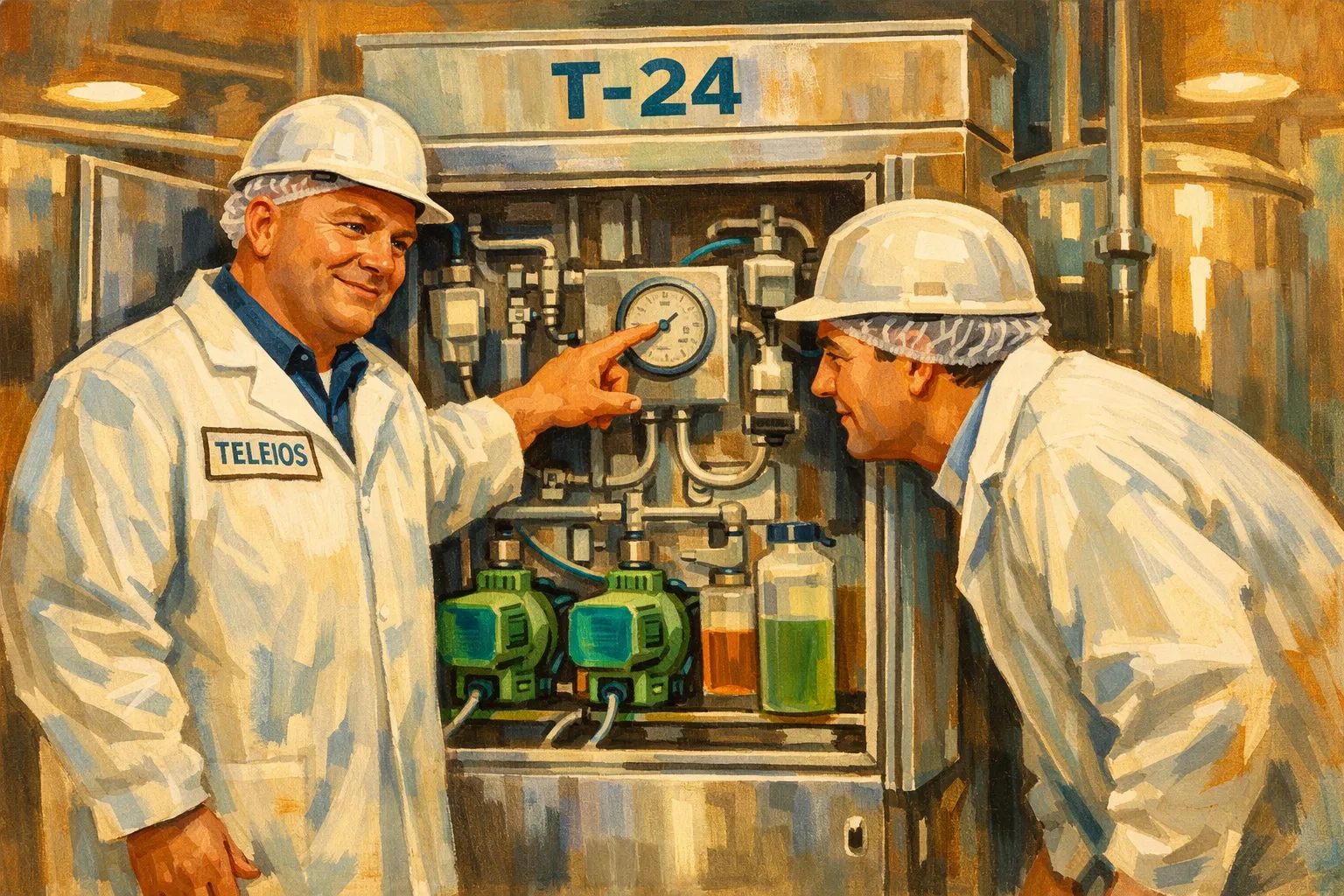
T-24

Sodium peracetate · on-site generated

Our patented sodium peracetate antimicrobial. Generated fresh, on demand, from food-safe inputs. No bulk PAA in the yard, no concentration decay between shipment and use, no delivery dependency.

BUILT AROUND THE KILL · NOT THE CONSTRAINTS
▸ 02 SUPPORTED
PAA

Peracetic acid · supported where it earns its place

PAA is effective. We support it where it is the right tool for the plant — and where the plant is not ready to overhaul the program in one move. Optimization first, conversion when the data calls for it.

PROGRAM OPTIMIZATION · HONEST COMPARISON
▸ 03 PROCESS
Caustic

As part of broader intervention and process needs

Where the line calls for it. Sequenced into the program where the chemistry and the process actually require it — not as a default and not as a workaround for something the antimicrobial program should be doing on its own.

SEQUENCED · CONTEXT-SPECIFIC
What we bring is focus. Intervention chemistry is what we do. Compare the Chemistry
A PAA ALTERNATIVE · T-24

A PAA Alternative
Built for Process Control.

The reason T-24 matters is not the technology itself. The reason it matters is what it changes about the QA conversation. The intervention program is built around the kill — not around the constraints. Concentration is set to meet microbial targets, not to keep odor below a complaint level or to keep maintenance from raising its hand.

▸ HOW T-24 CHANGES THE PREMISE

A traditional PAA program asks plants to manage trade-offs in exchange for performance. T-24 is designed to reduce those trade-offs — to give QA, operations, and maintenance a single program that can run at the concentration the data is asking for.

▸ NO.
▸ CLAIM
▸ PROOF
01
2+ log microbial kill
Laboratory study · validation summary
02
No noxious odor
SDS · safety assessment · testimonial
03
pH 9–12 · alkaline, product-friendly profile
Technical data sheet
04
On-site generation, fresh on demand
System schematic · process diagram
05
~40% lower BOD impact
Environmental assessment
06
Lower corrosion profile
Materials compatibility summary
07
Food-safe feedstocks
Ingredient & regulatory documentation
Every performance claim above will link to the supporting document before publication. Trust is built on proof, not assertion. Get the T-24 Data Kit
AN HONEST SIDE-BY-SIDE

T-24 vs. Traditional PAA.

PAA is effective in poultry interventions. It has earned its place, and a side-by-side comparison should reflect that honestly. The point of the table below is not that PAA is wrong — the point is that plants comparing options deserve to see the trade-offs clearly, in one place.

01 Microbial performance
▸ TRADITIONAL PAA

Effective and widely used; performs well against Salmonella and Campylobacter

▸ TELEIOS T-24

Positioned for comparable kill with different plant-level trade-offs

02 Odor
▸ TRADITIONAL PAA

Can constrain how aggressively plants run chemistry

▸ TELEIOS T-24

No noxious odor

03 Corrosion
▸ TRADITIONAL PAA

Acidic and oxidizing; equipment concerns over time

▸ TELEIOS T-24

Lower corrosion profile

04 Product quality
▸ TRADITIONAL PAA

High concentrations associated with yield concerns and carcass graying

▸ TELEIOS T-24

Alkaline (pH 9–12); positioned as product-friendly

05 Logistics
▸ TRADITIONAL PAA

Bulk chemical storage and delivery dependency

▸ TELEIOS T-24

Generated on-site, fresh on demand

06 Process control
▸ TRADITIONAL PAA

Concentration affected by chiller conditions, organic load, and measurement

▸ TELEIOS T-24

Generated fresh with monitoring-oriented design

07 Service model
▸ TRADITIONAL PAA

Often vendor-dependent and slow to respond

▸ TELEIOS T-24

Blue Ribbon Service ties support to plant KPIs

High PAA concentrations have been associated with yield losses, carcass graying, employee hazards, and increased cost. Those are real plant-level consequences — and they deserve to be part of any honest comparison.

Get the T-24 Data Kit
THE BUYING TABLE

One Intervention Program. Six Key Conversations.

The best poultry antimicrobial program does not only satisfy QA. It has to survive the full buying committee — food safety, operations, maintenance, safety, procurement, and corporate. A program that wins on one scoreboard and loses on the other five is a program waiting to be replaced.

SEAT 01▸ STAKEHOLDER

QA Manager

▸ YOU NEED

Consistent performance, validation, and a program that holds up in an audit.

▸ TELEIOS BRINGS

Teleios builds chemistry decisions around data — not around the odor the plant can tolerate.

SEAT 02▸ STAKEHOLDER

Food Safety Manager

▸ YOU NEED

Microbial control, FSIS readiness, the documentation that supports Category performance.

▸ TELEIOS BRINGS

Programs designed to support process control and produce the records you need before you have to go looking for them.

SEAT 03▸ STAKEHOLDER

Plant Manager

▸ YOU NEED

Yield, turnover, downtime, cost, and customer specs — all moving the right way at the same time.

▸ TELEIOS BRINGS

We help you manage the cost of your intervention program and improve overall efficiency week after week.

SEAT 04▸ STAKEHOLDER

Maintenance Manager

▸ YOU NEED

Chemistry that does not punish your equipment and a vendor who shows up when something breaks.

▸ TELEIOS BRINGS

You get boots on the ground service built with maintenance in mind — not as an afterthought.

SEAT 05▸ STAKEHOLDER

Worker Safety · EHS

▸ YOU NEED

Fewer odor complaints, fewer exposure incidents, a lighter safety burden.

▸ TELEIOS BRINGS

Programs designed to lower the safety friction that comes with aggressive chemistries.

SEAT 06▸ STAKEHOLDER

Complex Manager

▸ YOU NEED

Multi-site consistency, proactive service, and overall cost control.

▸ TELEIOS BRINGS

We align intervention decisions with your most important KPIs and run regular reviews against them.

One program. Six scoreboards. All six matter.

THE SERVICE LAYER · BLUE RIBBON

Blue Ribbon Service:
The System Behind the Chemistry.

Chemistry is only as strong as the system keeping it right. Blue Ribbon Service connects the intervention program to your plant's KPIs — and keeps reviewing the data, conditions, and calibration after the sale. A defined workflow, not a vague promise.

▸ WHAT THE SERVICE LAYER DELIVERS EVERY WEEK · EVERY YEAR
01
Weekly written report KPIs against target, in your inbox — not when you ask.
02
Bi-weekly working meeting A real L10, where what isn’t working gets written down.
03
90-day scorecard Documented results your team can hand to corporate.
04
One point of contact Same person, same plant, same phone number.
FOOD SAFETY · HACCP · PROCESS CONTROL

Built for the Records QA and Food Safety Need When the Questions Come.

Poultry intervention programs have to perform in the real world and hold up in documentation. Teleios programs are evaluated around validated use, process monitoring, plant-specific conditions, and the records your team needs when questions come up — from auditors, from customers, or from FSIS.

FSIS performance standards apply to Salmonella and Campylobacter in raw chicken parts and not-ready-to-eat comminuted chicken and turkey products. Meeting them is a plant-level effort that depends on process design, sanitation, intervention chemistry, monitoring, and documentation working together.

▸ DOCUMENTATION POSTURE HACCP-ALIGNED
01
▸ Validated use
Documented per intervention point
02
▸ Process monitoring
Concentration · dosing · trend
03
▸ Plant-specific records
Plant ID · shift · line · operator
04
▸ Audit posture
Reviewable by QA, customer, FSIS
Teleios supports the intervention piece — with attention to how the program supports HACCP, generates records, and stands up under review.
START HERE · NO PRESSURE

Find the Hidden Costs in Your Current Program.

If your current intervention program is protecting food safety but creating odor complaints, corrosion, product quality concerns, concentration compromises, or service gaps, Teleios can help you review the system point by point.

A performance review is a focused conversation. We map your intervention points. We look at where chemistry is performing and where it is creating hidden cost — whether that means optimizing your PAA program, piloting intervention at one point, or building a different program from the ground up.

▸ NO PRESSURE· NO COMMITMENT· JUST A CLEARER VIEW
What is poultry antimicrobial intervention? +
Poultry antimicrobial intervention is the use of approved antimicrobial processing aids, equipment, monitoring, and validated procedures at key points in poultry processing to reduce pathogen risk and support process control. A complete intervention program includes the chemistry, where and how it is applied, how it is controlled and monitored, and how the program is supported and documented after installation.
Where are antimicrobial interventions used in poultry processing? +
Most poultry plants apply interventions at inside-outside bird washers, chillers, post-chill dips or sprays, cabinets, and other validated treatment points specific to the process. Chilling and post-chilling are particularly important microbial control points, and post-chill applications often use short contact times through immersion or spray.
What pathogens do poultry antimicrobial programs target? +
The primary targets are Salmonella and Campylobacter. Program design depends on product type, process flow, regulatory requirements, and plant-specific data. FSIS performance standards apply to Salmonella and Campylobacter in raw chicken parts and not-ready-to-eat comminuted chicken and turkey products.
Is PAA effective in poultry processing? +
Yes. Peracetic acid is effective and widely used, and has largely replaced chlorine as a preferred antimicrobial in many poultry applications because it performs well against Salmonella and Campylobacter and is less affected by organic matter. Plants choosing PAA should also account for odor, corrosion, product quality at higher concentrations, concentration control in the tank, worker comfort, and total cost of the program.
What is a PAA alternative for poultry processing? +
A PAA alternative is an antimicrobial program designed to meet pathogen-control goals while addressing some of the trade-offs that come with traditional PAA — odor, corrosion, product quality, concentration drift, and logistics. Teleios offers T-24, an on-site generated sodium peracetate antimicrobial positioned as lower-odor, lower-corrosion, and product-friendly.
Why does PAA concentration change in poultry chillers? +
PAA stability in chillers can be affected by chiller chemistry and operating conditions — total dissolved solids, pH, temperature, fats, oils, and proteins — as well as by sampling timing and measurement practices. The result is that the concentration measured on a test strip may not match the actual working concentration in the tank, which has implications for microbial performance and program documentation.
How does Teleios' Blue Ribbon Service support intervention performance? +
Blue Ribbon Service is the accountability layer behind the chemistry. It includes a baseline plant review, intervention-point mapping, KPI alignment, installation and training, monitoring and calibration, weekly check-ins, quarterly scorecards, and critical response. The goal is to keep chemistry decisions tied to plant outcomes — not just to delivery schedules.